

Your Custom Text Here
Why Do You Need A Writing Coach?

Writing is solitary pursuit. It’s just you and the cursor blinking on the blank page.
And we all know that to succeed as writers, we need to sit there with that blank page until we put words on it, day in and day out.
But we are social creatures.
We need feedback and camaraderie.
We need to feel like someone is listening to us; like we’re not just putting words out into the void.
We need validation that our ideas aren’t trite and stupid.
And sometimes we need the point of view of another to help us find the best way to make those ideas shine.
I started editing by helping my friends write their papers and stories in college. I loved reading what they wrote and then sitting down next to them to talk it out.
“What are you trying to say here?” I’d ask.
Or, “It sounds like this is your main idea, but then you have these other paragraphs. What’s the central point you’re trying to make?”
And the most fun ones: “No way your character would do that—remember what you said before about what they really want out of life? This undercuts that. What if they do this instead?”
This collaborative approach to writing and editing is the reason I do this work.
If you’re struggling with your writing projects—whether it’s:
having the discipline to sit down and write every day,
or working up the courage to finish a piece you’ve been working on for a while,
or you’ve written yourself into a corner and you don’t know how to get unstuck,
or you need help organizing your ideas to get started,
or you just want someone to bounce ideas off,
a writing coach can help you with all of that—and more.
A writing coach is kind of like a mentor, a consultant, a buddy, and a cheerleader all rolled into one.
If you feel like you’re lost in the wilderness of writing and you’re looking for a guide, please check out my Writing Coach Services page to learn more about what I offer. From there you can also contact me for a free 15-minute phone consultation to create a fully customizable program made just for you.
New Stories and Articles!
I’ll still be periodically updating this blog, but I have recently begun contributing stories and articles on Vocal Media, a platform for supporting, discovering, and rewarding creators.
Check out my Vocal profile for more frequent updates to my writing portfolio here.
How To Work From Home Like a Boss

I've worked from home full time for about four years now.
While many people I know say they couldn’t handle the isolation, for me it’s the only way to work. I’ll never go back to an office building—I’ve gone feral.
The benefits of working home are many:
I control my schedule and my environment.
I don't waste ten hours a week commuting.
I have more time for health and fitness.
I can have daily dance parties with my cats.
But while I would choose working from home any day over going back to an office, there are a few drawbacks:
The long stretches without human contact.
The ease of falling into unproductive habits.
Other blog posts might give you pointers on how to be as productive as possible, but this one focuses how to retain your humanity. These tips are key to avoiding burnout and ultimately being more productive in the long run.
Here are things I've learned that keep me sane and productive:
1) Get dressed.
Working in your pajamas sounds great, but it's actually not. When I get up in the morning, I put on clothes to start the day. Granted, they are usually soft and loose-fitting clothes, often athletic wear. But the point is to put something on that you could wear out of your home. It signals that rest time is over and being-a-boss time has begun. Plus, it helps with the next tip…
2) Find reasons to go out.
It's very easy to get sucked into your work and not leave your home all day. I find that I'm far more engaged in my work on the days that I have a reason to leave the house. The break changes my perspective and gives me a second wind. It can be something as simple as a walk outside, a short session at the gym, or trip to the grocery store (another benefit of working from home is that you can run errands at times when most people are at work),
These trips also give you chances to interact with other people, and they can make you appreciate interactions that you might otherwise take for granted. I find that I’m friendlier and more open to my neighbors, other customers in stores, and checkout people—and I often have conversations with them that put a smile on my face.
3) Do things that are real.
This is somewhat related to the last item, but it can be accomplished in your home. Most of us who work from home also work online. I find it difficult to live my entire life through a computer screen, so it’s refreshing to use my breaks from work to do something "real."
By this I mean something that has physical consequences in my immediate world. It could be practicing yoga or making a craft, but for me best ones are cleaning around the house and preparing healthy meals. These breaks snap me back to life and remind me that I am a human animal that exists in a real place.
Another good way is to bring life into your home. Pets and plants cannot replace human interaction, but they can tether you to the real world. Having to feed your pets and water your plants are good reminders you that you need to do those things mindfully for yourself as well. And a small bit of affection from your animals can hearten you when you're feeling discouraged. If you don't want or can't have pets in your home, a good way to liven up the day is with a bird feeder. Looking up to see what kinds of birds are visiting is a great break from the screen, as your eyes should be allowed to adjust to different distances throughout the day to avoid strain.
4) Eat well.
When you work in an office it can be hard to eat well. Even when you pack a healthy lunch, it’s hard to turn down an invitation to the local greasy spoon or your favorite pizza place. And all the offices I've worked in were constantly filled with sugary baked goods and treats brought in by my coworkers that were tough to avoid when they sitting next to my desk all day looking delicious.
It's easy to get caught up in your work and just grab something quick to eat on your break. Sometimes going out to get food can be a good break or treat (see #2), but for the most part you're going to be eating what you’ve got in the fridge. So stock it with good things!
If I have junk food in the house, I'll eat it. If I have fruits and nuts, then that's what I'll have.
5) Listen to (the right kind of) music.
Depending on the work you do, you might need quiet to focus. Much of my editing work is very technical, so listening to music can be distracting. But music also keeps my spirits up, making the day go by faster and more happily. I listen to a wide range of genres, but recently I've realized that it's only music with lyrics that distracts me when I'm editing—instrumental music does not. Spotify has bunch of playlists under the "Focus" genre that are good for listening to while you work. Adding music to my day keeps me feeling good.
Working from home means having way more freedom than being in an office. Use that freedom to develop positive habits that keep you sane, productive, and enjoying your work!
Writing Inspiration: Reading
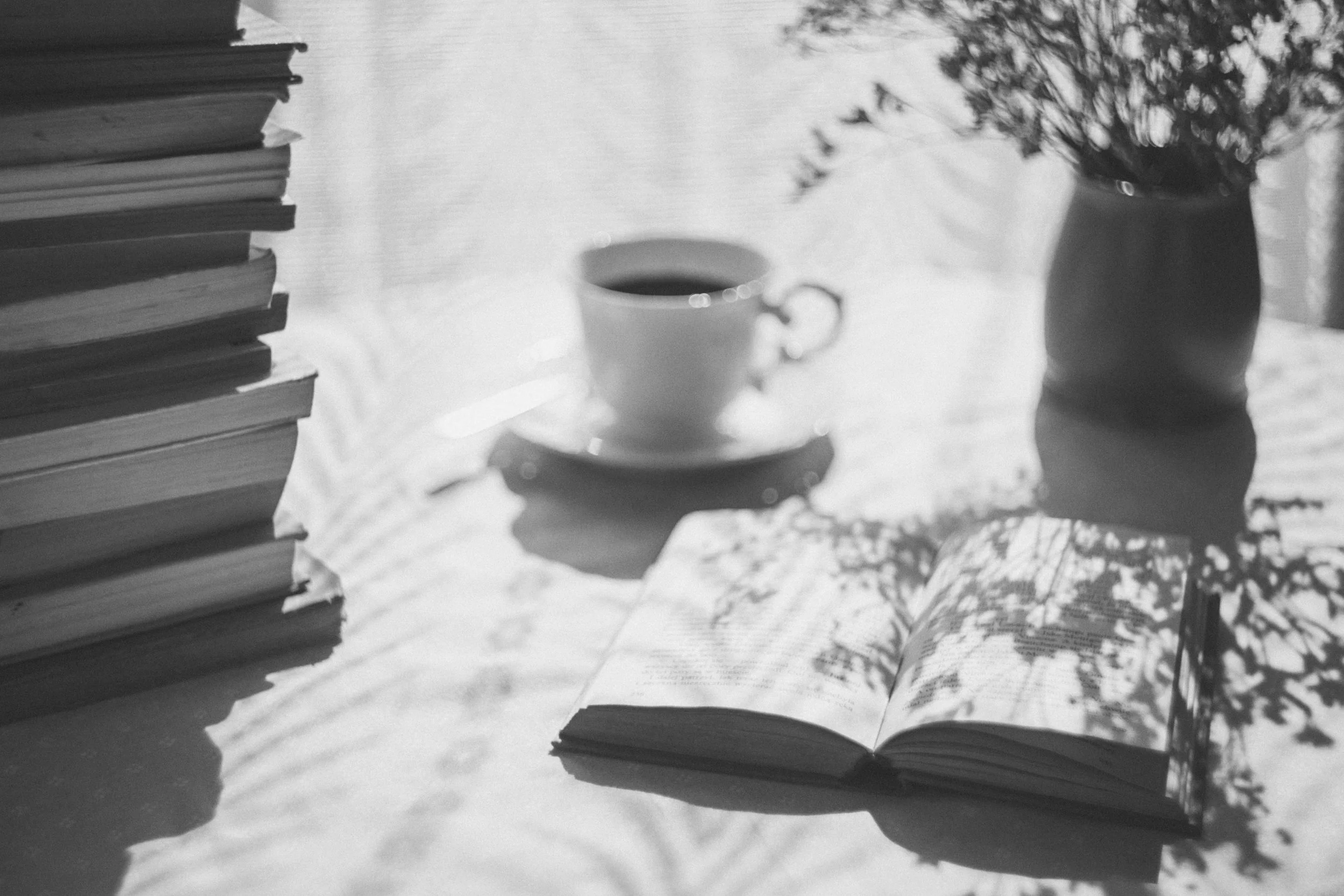
Reading is simultaneously one of the biggest obstacles to my writing and an absolute requirement for it.
Given a choice between reading and writing, I will choose reading nine times out of ten. Reading is my default setting. It seems to operate on my mind in the same way that mental states like meditation and dreaming are purported to work. When you're meditating, the aim is to let thoughts flow through your mind, to not hold onto them and just watch them go by. When I'm engrossed a good book, the thoughts flow by this way; I'm in the moment within the story. Both dreaming and meditation are supposed to be resets for your mind, a way to clear out all the garbage we hold onto and perhaps become anxious and depressed about. Reading takes you outside of yourself, and it invests you in situations and problems that are not your own for a while.
If I don't read for a couple of days, I start to become irritable in a similar way that I do if I haven't had enough sleep or exercise recently. If I don't have a book in my bag or beside my bed with a bookmark keeping my place, I don't feel grounded. And carrying home a big stack of books from the library gives me the same sense of satisfaction as getting lots of good things to eat at the grocery store; it's the sense that my larder is full, and I can count on being nourished for the near future.
And that's the crux of it: reading is the nourishment that allows me to write. You have to fill the cup before you can drink from it.
It absolutely astonishes me how little most people read. I suppose since it's so integral to my life, I can't imagine that it isn't that way for everyone. It's easy to blame the internet; even with that satisfying stack of books piled next to my bed, I often find myself enticed into scrolling through nonsense articles on my phone rather than getting engrossed a book. That goes on until a vague sense of irritation begins; I realize that I'm not doing what I want to do and that what I'm doing is an inferior experience. It's like I'm filling up on Nerds while a big, juicy steak grows cold beside me.
I'm not saying that everything that one can read on the internet is empty, sugary garbage. I'm just saying that much of it is, and it seems to be proliferating. If “you are what you eat,” then as a writer you are what you read. Many people who write on the internet read on the internet. And I would argue that the format itself, the speed at which it can be tossed off—largely unconsidered and typically unedited—contributes to not only the decline of quality of thought but also to a destruction of peace of mind.
Neil Postman wrote about this in Amusing Ourselves To Death in 1985. He talked about how “form excludes content,” the concept that different kinds of media can only sustain certain levels of ideas. He referred mostly to TV and to the fact that television news was becoming “entertainment.” This was long before the current juggernaut of the 24-hour news cycle, the pervasiveness of unearned celebrity in the form of reality television, and the internet's inundation of content for content's sake, but it is prescient about the consequences of the early indicators that, through a dilution of discourse, we might be heading in that direction. In the introduction to the book, he writes about the possibility that when it came to dystopian views of our future, we feared the wrong thing:
We were keeping our eye on 1984. When the year came and the prophecy didn't, thoughtful Americans sang softly in praise of themselves. The roots of liberal democracy had held. Wherever else the terror had happened, we, at least, had not been visited by Orwellian nightmares.
But we had forgotten that alongside Orwell's dark vision, there was another—slightly older, slightly less well known, equally chilling: Aldous Huxley's Brave New World. Contrary to common belief even among the educated, Huxley and Orwell did not prophesy the same thing. Orwell warns that we will be overcome by an externally imposed oppression. But in Huxley's vision, no Big Brother is required to deprive people of their autonomy, maturity and history. As he saw it, people will come to love their oppression, to adore the technologies that undo their capacities to think.
What Orwell feared were those who would ban books. What Huxley feared was that there would be no reason to ban a book, for there would be no one who wanted to read one. Orwell feared those who would deprive us of information. Huxley feared those who would give us so much that we would be reduced to passivity and egoism. Orwell feared that the truth would be concealed from us. Huxley feared the truth would be drowned in a sea of irrelevance. Orwell feared we would become a captive culture. Huxley feared we would become a trivial culture, preoccupied with some equivalent of the feelies, the orgy porgy, and the centrifugal bumblepuppy. As Huxley remarked in Brave New World Revisited, the civil libertarians and rationalists who are ever on the alert to oppose tyranny “failed to take into account man’s almost infinite appetite for distractions.” In 1984, Orwell added, people are controlled by inflicting pain. In Brave New World, they are controlled by inflicting pleasure. In short, Orwell feared that what we fear will ruin us. Huxley feared that what we desire will ruin us.
This book is about the possibility that Huxley, not Orwell, was right.
If you look at the current state of writing, or “content development,” as it is now termed by the marketers, you can see that Postman and Huxley were right. We are drowning in a sea of irrelevance, in the form of memes and listicles, thoughtless opinion pieces, and incendiary tweets that are attention seeking rather than thought provoking, that are aimed at generating clicks and likes rather than mature discourse or insightful reflection. I can’t think of better words to describe the consequences of people’s constant scrolling through Facebook than “reduced to passivity and egoism.”
The articles I read on the internet, even when they purport to be think-pieces about important subjects like politics or science, are often so disappointingly pointless. They are not well thought out or organized, and they do not contain anything but regurgitated soundbytes and buzzwords that can be relinked back to other articles that say essentially the same (no)thing per SEO best practices. They do not refine anyone's thoughts or enhance anyone's lives. If anything, they increase the division of our attention and promote anxiety. They cultivate the feeling that you're missing out because how could you possibly click on all of the branching links to get the full picture and context of the discussion? You can't. Because there isn't any context, and there isn't really a discussion. Readers of this type of content are not filled with knowledge or even facts. They only thing people seem to be filled with is outrage, which the comments section provides an arena to thoughtlessly vent, thereby fomenting further outrage in others.
We've become a society of people who are so addicted to attention and stimulation that we are all talking at once. No one is listening to each other, or even, it seems, to themselves.
I don't believe that all books are better than all writing on the internet. Frankly, it seems like most of the books coming out these days are either memoirs of reality stars (which are essentially ghostwritten prequels to their TV shows and tabloid stories) or compilations of popular Tumblrs. And in the world of “serious” nonfiction, there is certainly a fair share of the same fanatic, gushy dreck that you can find for free online. Fiction, too, is a playground for market-driven, formulaic books from writers who have somehow convinced themselves that they are reaching some sort of po-mo transcendence by subverting the art of storytelling through technology and new media, but who, like everyone else, have merely placed another offering on the altar of the cult of Look At Me.
However, there is something in the form of a book that requires a deeper commitment to denying distraction. It requires attention and memory retention and focus. It requires the reader to approach the author's ideas as something to be digested and weighed against his own perceptions and understanding of the world, rather than approaching them as clickbait or a product to be consumed and then flaunted—I mean “shared”—to one’s social media circle.
Reading books makes one a better thinker, and being a better thinker can make one a better writer, one that is more considerate of priorities. Reading good writers also improves one's writing. The community of content creators online needs to take a step back and consider what we are writing and whether it is contributing anything—not to the conversation, as in idle chatter, but to discourse, as in meaningful discussion of things that actually matter. We also need to consider what we are reading, to commit to nourishing themselves with quality stories and ideas. It will inspire us all to become better writers.
Writing Inspiration: The Meditation of Movement
Writing requires a certain mindset.
For me there is always a struggle to find the right balance between the beautiful flowing mania of words tumbling out onto the page in the passion of tumult and the measured, thoughtful pace set by the discipline of sitting down every day to work at it.
One has to accept that both of these extremes are part of writing. But what is required to navigate them is peace of mind.
There's a ton of press about the benefits of meditation for mental and physical health, brain functioning, management of anxiety, and pretty much every area of life. The typical advice is to take some time out of your day to sit quietly and still, emptying your mind.
Stillness can be beautiful. Lying in bed upon waking, sensing the light flooding into my room behind eyes that I refuse to open because I won't yet capitulate to the morning march, I am still. I let the compass in my mind reorient itself to the land of the waking, and I stay still until the slowly sweeping needle finds the direction of the day.
There is also beauty in animal stillness: the slowing of movement and tamping down of the interior inferno in order to be in tune with the nonhuman world. Walking into the sweet, sacred space of a horse’s stall or settling myself down next to a cat who is deciding whether she wants my company, I am still.
The stillness of those moments brings me a kind of peace that I cherish; but it is not the peace of mind required for inspiration. It is a passive sort of relaxation.
I often find that I need movement to reach the kind of peace that inspires me. It is an active relaxation wherein my mind seems to operate most creatively when my body is in motion.
I am at my best when I'm driving. The movement of the car beneath me and the changing view out the windshield combined with the powerful feeling of freedom to control my direction, the sort of background-running attention that the actual task of operating the car takes, and the inspiration of the music on the radio all contribute to a perfect atmosphere for the functioning of my mind. I think more creatively and confidently in the car than anywhere else.
After driving, the next best state is that of movement powered by my own body. I'm always walking things off: fights, frustrations, frenzies. The movement of my body has a very grounding influence. When thoughts are scary or overwhelming, going for a walk or a run (especially in nature) always calms me. Perhaps the use of my body is a reminder that I am real, I am alive, and I am healthy—and that no matter what the thoughts contain, I can handle them and survive. After I move, I can return to problems with fresh eyes and so much more easily fix or finish things that before seemed to have no solution.
One of the best things about being a freelancer is the opportunity it gives me to get up from my work and move around freely. Theoretically, this is possible when you're working in an office. The meditation of silence and stillness wouldn't be disruptive to your coworkers, but people would probably look askance at you if your breaks consisted of a round of jumping jacks or a series of yoga poses.
Just as introverts and extroverts recharge themselves differently (being away from people and being surrounded by people, respectively), I think there are different camps of people who refresh either through stillness or through movement. I certainly fall into the latter camp. Next time you're stuck, frustrated, bored, tired, in a towering rage at how slow your computer is operating, or just plain antsy, try it. Get up and go for a walk, do some calisthenics, or, as Peter Gabriel suggests when he wants to “run away,” drive off in your car. Whatever your preferred method of mobility, engage in the meditation of movement and see how it works for you.
Writing Inspiration: Nature
Nature is a necessity.
Humans have some basic needs. Food, water, and shelter are the fundamental biological needs without which we will die. But to go beyond mere survival, to be whole, there are some psychological needs that must be fulfilled. Nature is one of these. It may be one of the most important, and it is also one of the most neglected.
In his essay Wordsworth in the Tropics, Aldous Huxley distinguishes between the tame, cultivated Nature of the English country garden (the virtues of which are extolled by Wordsworth) and true Wilderness which, although “marvelous, fantastic, beautiful,” can also be “foreign, appalling, fundamentally and utterly inimical to intruding man.” It is “alien to the human spirit and hostile to it.”
At minimum, I believe access to Nature is a requirement for a worthwhile, healthy, sane life. The thought of living in an urban highrise with a view of only other skyscrapers is hellish. To only allow my feet to touch concrete and never dirt, moss, fallen leaves, or sand; to only be exposed to fluorescent lighting and climate-controlled air and never feel sun or rain or breeze on my skin; to see only manmade shapes with everything at right angles and never to let my eyes wander among the intricacies of bark on tree limbs or rest in the symmetry of leaves; to constantly be exposed to the din of human life and enterprise and never the tranquil lull of birdsong or the near-silent hush of an empty field at night is to become malnourished, deformed, and demented.
One can live a life in the city and fall into a pattern in which there is almost never a chance to be exposed to nature. Or one can find small ways to incorporate nature into even an urban lifestyle (Lyanda Lynn Haupt wrote a good book about this called The Urban Bestiary). The key is finding the right balance, the ideal being to live in a place that is suffused with nature while providing the necessary infrastructure for our modern lives and also having relatively fast and easy access to wilderness.
Even when I have access to nature, I still crave wilderness. Wilderness may be, as Huxley says, alien and hostile to the human spirit, but that may be exactly what makes it inspiring. It pushes us to a realm of nonhuman concerns and forces us outside of ourselves, making room inside of us for the transcendent. Wilderness seems to be where what is left of the magic in the world still resides. Yes, it is wild and dark and uncontrollable. But belonging to a culture in which we have sanitized and motorized and categorized everything into marketing verticals, we need to expose ourselves to the wild to remind ourselves that we are animals, too. We must not neglect that animal part of ourselves because it is part of what makes us human. Without it, we become frighteningly like robots.
A hike in the woods, a trail ride through fields on my horse, a kayak trip down a river, or an afternoon on a lake in a canoe: these are essential escapes for me as a writer because they are necessary for me as a human being. Without them, my life becomes unbalanced in ways that nullify any efforts at creation. You can't create when you are empty. In nature and in wilderness, I find endless inspiration. Describing the beauty and capacity for solace as well as the vast, irrational, frightful quality that inspires terror and dread is probably the main subject and theme of most of what I write. Writing and storytelling are how humans make sense of our lives and our place in the universe. That exploration is inseparable from nature and requires the perspective upheaval caused by encountering wilderness.
For further reading on the importance of our connection to nature and wilderness, I highly recommend the writings of John Muir and Rachel Carson. You can also find other books on the subject on my Goodreads Wilderness shelf.
Word Play
I love playing with words.
They are perhaps the most fun toy in the world because with them you can make anything.
Traditional word games like crosswords and word searches are great—I await the Pennysaver eagerly each week because it contains both of those things and I like the way the pen feels on that newspapery paper as I write in my answers in careful, all-caps lettering or make my circles, trying not to let them touch any of the printed letters.
Board games based on words are my favorite kind, and are subsequently the kind that people least enjoy playing with me. Scrabble can become (mostly jokingly) controversial with people who try to convince me that their made-up words are valid, and I preside over the board with a dictionary to keep things legitimate. Scattergories is another one I can play for hours and hours, rifling through the stacks of words in my brain and unearthing them by letter and category.
Then there are the Jeopardy categories that require a nimbleness with words. I always do best on those—the ones that start with or have to contain a certain letter or sequence of letters are easy for me, but the ones with the before-and-after are a fun challenge. I like these categories better because they feel more involved than straight trivia; they require knowledge of the words but also the manipulation of that knowledge in clever ways. Same with any questions about foreign language terms; making guesses based on the similarity of the root of a foreign word I don't know is exciting, and of course very satisfying when I get it right. It's not just that I love getting correct answers—it's like there's an ever-growing forest of language in my brain, and I've just found a way to swing from the branch of one tree to another.
But probably my favorite kind of word play is the realm of neologism and nonsense. Those close to me are aware of (and often infected with) a largely emotionally driven, onomatopoeic dialect that I have cultivated throughout the years, in which I might tell you that I'm “meeping” or ask you if you're “crinched.” I just assume most people will intuit the meanings of these through sound and context, but if pressed I can provide detailed definitions.
“Meeping” is of course the act of being sad about something, but in a small way. It isn't as petulant as pouting and it’s not as dreary as moping—you'd rarely cry if you're meeping, but things could always take a turn for the more emotional if you’re feeling meepish.
“Crinched” seems to be a sound combination of “cranky” and “pinched,” and it refers to a state of being slightly annoyed, uncomfortable, and bothered—more annoyed and with a harder edge than if you were just miffed, and with a little more anger. Being crinched isn’t a very persistent state though; it's like your nose is out of joint but it shouldn’t take much to put it right. If you're squinched, though, it make take a little more effort to bring back a sunny mood.
Another part of this dialect of mine is a kind of phrase or expression that I refer to as a “brainbreaker.” If I hear them or think of them, I can physically feel things going haywire inside my brain. The rest of the day will be a bit more distracted and off-kilter because of their presence. Most people find these things totally innocuous and unremarkable, but when I hear them or say them, that's it for me. Some of the all-stars in this category are dogfood commercial, cat calendar, and probably the most destructive, salt lick. (I just stopped writing and helplessly laughed for an entire minute.) These phrases find their way into my consciousness when I am tired or otherwise distracted, and they've become filler utterances when I'm muttering to myself or at a loss for what to say.
A whole game sprouted up during my college years from this kind of nonsense phrase. My oldest friend and I would try to come up with good ones and go back and forth trying to outdo each other by putting together words that by sound and/or definition were amusing in combination. It was called “Susan In A Cup,” and although there was no formalized point system, extra prestige was awarded for thinking of ones that already existed within our language, such as “cauliflower ear.”
Clearly I've always been like this. I'm aware how incredibly nerdy all of this is, but I don't mind. Being an only child makes you come up with creative ways to stave off boredom, and the ability to amuse myself (although perhaps no one else) with these games is something I cherish. With words and language as playthings, I'll never be bored.
Writing Inspiration: Fairy Tales
I have always been drawn to fairy tales.
Their simplicity and symmetry have an appeal that seems innate, like the shape and symbol of a circle. I love stories of all kinds, but the enjoyment of fairy and folk tales seems to reside on a deeper level of consciousness.
Of course, that's a very Jungian outlook. It's a very comforting idea that there could be a collective unconscious that we all have access to and through which certain, fundamental aspects of life and humanity—the archetypes—are expressed across cultures worldwide. That despite the intense alienation and loneliness one may feel in times of strife (and I suspect that during all times in history, the denizens of each time period have always felt that theirs is the worst, most contentious time), there is something unifying at the heart of the human experience. That maybe even in the face of those feelings—your anger at that person who cut you off on the freeway; your disgust at the people whose demented, anxiety-driven priorities perpetuate a vapid and senseless consumerism that torpedoes any hope for honest, productive discourse about how to make life better for as many people as possible; your utter, hopelessly frustrated rage at the childish and greedy behavior of the world's “leaders” as they destroy the lives of countless people to secure their own power and wealth—perhaps you can, through the shared tradition of stories, folktales, and myth, find a bridge back to what may be worthwhile in humanity.
I'm currently reading Fairy Tales From the Brothers Grimm: A New English Version by Philip Pullman, the man who wrote the His Dark Materials Trilogy (the first book is The Golden Compass). Of the 211 tales included by Jacob and Wilhelm Grimm through the seven editions of their collection, Children's and Household Tales, Pullman has chosen fifty of what he considers the “cream” and has retold them.
I have read about half of them so far, and it seems that Pullman is showcasing the stories that highlight one of the major themes of fairy tales—the punishment of the wicked and the reward for the good. In so many stories, “Cinderella,” “The Frog Prince,” “The Three Little Men in the Woods,” “Faithful Johannes,” and “The Twelve Brothers,” to name a few, those who scheme, lie, and hurt others are punished by either death or a life of unhappiness, and those who are true to their word, selfless, and helpful are rewarded with riches and the proverbial “happily ever after.”
This common motif in fairy tales and folk tales across cultures not only makes them instructive and cathartic, it presupposes that these are common values that are desirable to us all. But is that really true? If we all really wanted that, would we need hundreds of cautionary tales warning us of the consequences of pursuing other paths to fulfillment? It took me thirty-five years to understand that not everyone desires peace.
__________
In the introduction, there is a section that I find very interesting, entitled “This Is Not a Text.” Pullman makes the point that unlike literary works, which are primarily texts that are required to be consistent among different editions, fairy tales and folk tales are instead transcriptions of words that have been spoken by one of many tellers of the tale throughout time. As such, they can be altered by the teller. Different tellers of the tales may recount them according to their personal style; one may have a comedic approach, while another highlights the suspense and drama.
This made me consider my own way of storytelling. What do I highlight? What are the important parts of a story for me? I think my main focus is the psychological motivations of my characters and the implications of those motivations for their connections with each other. But looking at my writing through this lens I also recognize that I often focus on descriptions of the characters’ relationships with nature. Thinking about my storytelling this way gives me some insight into what I’m trying to accomplish with my stories, that is, explore the relationships people have with each other and their place in the world, which makes sense since that’s something I think about in my own life all the time. But as for the way of telling my stories, that’s something I’ll have to look into further. That's the fun part of finding your voice as a writer; trying different styles and ways of telling the story to see what suits you best.
But no matter the way in which you tell your stories, it is fairy tales and folktales, myth and legend, that are the raw material of storytelling—they are the elements we have to work with. That's especially true within the realm of speculative fiction—fantasy and sci-fi—which is the genre I most often read and write. They are the source of inspiration for storytelling of all kinds; there are myriad examples of these stories being retold, reworked, re-imagined in different configurations, settings, and time periods across all genre and all media. Even the tabloids that I can’t help but glance at in line at the supermarket seem to contain the same archetypal characters and story lines as the fickle, selfish gods of Greek myth and the wicked princes and evil stepmothers of the tales of the brothers Grimm.
Another great book to read on this subject, which focuses on fairy tales’ role in developmental child psychology, is The Uses of Enchantment: The Meaning and Importance of Fairytales by Bruno Bettelheim.
You can find that book and many others on the topic of myth, legend, fairy tales and folktales on my Goodreads shelf for the subject.
Writing Inspiration: Writing About Writing
There are about a zillion books out there containing writing about writing.
There seems to be an entire subgenre of the self-help world devoted particularly to helping you become the writer (or artist of any kind) that you're meant to be. I've read a few of these and find them to be a mixed bag.
There seems to be a spectrum of focus in these books. At one end you have the nuts-and-bolts practical guides to writing, including style guides, do's-and-don'ts lists, and advice on navigating the more business-oriented aspects of trying to get published. At the other end are the cheerleaders of self-expression books, the ones that give you permission to really be you, that exhort you to put yourself out there and give you idea prompts for taking yourself on self-indulgent little jaunts to find your creativity or whatever.
Wherever a book falls on this spectrum, there is usually some element of memoir involved where the writer of the book shares his or her experience of becoming a writer. This, too, can be helpful and relatable or totally solipsistic and pretty useless. There's the kind where authors share their very particular way of going about things that works for them and might work for you, too. And then there's the kind where the authors describe all of their neuroses so you know how very special they are and how you, too, can be a super special important person if you cultivate your own stable of hangups and self-limiting problems.
But when I do come across some writing on writing that clicks with me, it can be very inspiring. There are writers out there who I admire and who I think have real wisdom to share. Lately I read On Writing: A Memoir of the Craft by Stephen King and found it to be a perfect mix of all the things that a writer needs to read about. For my money, this book is in the ideal range of the spectra I described above. (You can read my Goodreads review by clicking on the link in the title.)
Since reading it a couple weeks ago, I have been sitting down to write every day. I've started work again on that fantasy novel I've been writing in fits and starts for a couple of years now and have a renewed sense of purpose and confidence with telling the story. I have also gotten sidetracked from working on that because fiction (and world-building fantasy in particular) is a lot of work, and sometimes it's easier to write blog posts about doing things I love, like this one. And that other one about horses. And an another one that I've been kicking around ideas for lately.
It's a hell of a lot easier to write about writing than it is to just write. Getting sucked into writing about it too much—or reading about it too often—can give you the false sense that you're getting the work done when you're really not. The only thing that can truly help you write is to sit down and write. But sometimes the encouraging words of someone who knows the joys and pains of the work that you do can be helpful to get you started. If you're looking for that, I highly recommend Mr. King's book. You can also click here for a list of some other books I've read on the topic and my reviews for them on Goodreads.
Evolution of Language: Idiomatic Degradation
I was on the subway listening but not listening to two guys talk about their workplace.
I wished they'd be quiet so I could read my book in peace, but then something one of them said really grabbed my ear. He said with chagrin that their office was just a “doggy-dog world.”
I was pretty much gobsmacked by this. I knew what he meant. The context made the meaning unmistakable. He clearly meant a “dog-eat-dog” world. But that's not what he said.
The origin of the phrase “dog-eat-dog world” is debated, but it seems to be related to a Latin phrase “canis caninam non est,” or “a dog doesn't eat a dog's flesh,” meaning that even a dog has limits and will not destroy its own kind. Humans apparently have no such compunction, and so we came to imagine living in a ruthlessly competitive world in which metaphorical dogs do devour each other.
But in the instance described above, the origin of the phrase doesn’t matter at all.
The man who said “doggy-dog world” used approximate sounds—essentially an idiomatic homonym—to convey the meaning that is usually assigned to the expression “dog-eat-dog world.” His meaning is clear, but at the same time what he said is divorced from meaning in that it has no connection to the cultural associations that made the words “dog-eat-dog” connote ruthless competition. An idiom is a combination of words that have a figurative meaning based on their common usage. “Doggy-dog” means precisely nothing. But if enough people start saying it in lieu of “dog-eat-dog,” perhaps its common usage will then transform it into the accepted idiomatic phrase. Would someone in the future researching the source of its meaning find that it has evolved—by sound alone and not by meaning—from the original idiom?
There is something infuriating about this all to me, a sense that idiots are mishandling something very precious, but I also find it fascinating. Being able to speak idiomatically is possibly the highest measure of language proficiency—I've known nonnative speakers who speak English so well I'd never suspect it isn't their first language, but they still had to ask me to explain the meaning of most idiomatic phrases. This is because idioms are derived from cultural sources that have nothing to do with the meanings of the individual words they contain; they reference historical and religious sources, literature, and custom. What happens, then, when the culturally rich idioms become degraded into essentially meaningless sounds? Does it matter, since most people are unaware of the origins of idioms as it is? Since they are agreed-upon signifiers, will the degraded versions simply take the place of the meaningful idioms? Is this another sign that our culture as a whole is becoming degraded, dumbed down, and separated from meaningful discourse?
I hope not. The less pessimistic, more playful side of me can almost enjoy this phenomenon. Language changes and grows, sometimes in unexpected ways. Maybe idiom is simply being scrappy, adapting in order to survive changes in the culture from which it derives. After all, it is a doggy-dog world out there.
Evolution of Language: Sarcastic Superlatives
When someone describes something as “terrific,” do you assume they mean it sarcastically?
I wonder if it would be possible to study the use of words across the internet and measure the ratio of how often they are used sincerely versus how often they are uttered with sarcasm. It might be difficult to quantify, given that sarcasm is usually indicated by tone of voice or some sort of physical gesture or facial expression, but certainly there are instances where even in writing the context is obvious. This seems like something Google should figure out how to do.
My guess is that the data would show that over the years—with the real shift beginning in the mid 1980s, after which it seems (to this child of the 80s) all the innocence began to leech out of the world—words like terrific, great, and wonderful have become increasingly used in a sarcastic context rather than with the intent of expressing genuine delight.
More old-fashioned sounding words, like splendid and grand, seem to be reserved for the highest pronouncements of mock enjoyment.
We have a great many words in English to describe things with extreme positivity: Marvelous! Awesome! Sensational! Stupendous! First-rate! Fantastic! Excellent! Superb! I see them all splashed across the page in colorful, bubbly fonts surrounded by clipart of smiley pencils and party hats like the stickers my kindergarten teacher would put at the top of little stories I wrote when I was too young to get actual grades on things. But when I read these words, I rarely hear that exclamation point. Instead I hear a deadpan period.
Are we just more negative, more complainy as a culture than we were before? Are we simply less easily impressed in a time when “innovation” in the form of a monthly parade of new and mostly useless gadgets vies for our esteem and attention? I don't know. When was the last time you felt moved to call something “stupendous!” in earnest?
Language evolves; words come in and out of style and change meaning over time. Take sentimental, once meant in a more positive way as “of or prompted by feelings of tenderness, sadness, or nostalgia,” like in Sam Cooke's song "I Love You For Sentimental Reasons." The modern connotation of the word seems to have a negative sense of being “overemotional, self-indulgent, mawkish,” like in the Radiohead song “Let Down”: “don't get sentimental / it always ends up drivel.”
So our superlatives are evolving. No longer needed in the service of describing how great things are, people are creatively repurposing them for expressing just how superlatively shitty everything is.
Writing Inspiration: Music
“Music has always been a matter of Energy to me, a question of Fuel. Sentimental people call it Inspiration, but what they really mean is Fuel. I have always needed Fuel. I am a serious consumer. On some nights I still believe that a car with the gas needle on empty can run about fifty more miles if you have the right music very loud on the radio.” —Hunter S. Thompson
Writing and music are deeply entwined for me.
Since childhood, I've connected songs—their lyrics, their moods, the feelings they evoke—with stories and daydreams. Something about listening to music puts my mind in an especially associative state. An only child who populated her lonely world with characters from books, movies, and TV, I wrote myself into their stories, joining them on their adventures but also finding my self and my place in the world through my relationships to them. So much of this was expressed through the soundtracks I created for the stories in my head: the songs I'd sing and that would be sung to me; the ones that would be playing on the radio at important moments.
When I got a little bit older and started watching music videos—MTV is sixteen days my elder, but I don't believe I began watching videos prior to Vh1's arrival in 1985 at the very earliest—the associations among songs and stories only grew stronger. Early music videos were a mixed bag of live concert footage, random and chaotic concepts and images, and occasionally mini-movies that told either the story of the song or a totally unrelated story. A vast store of images and tropes emerged from this (my favorite) art form, all made more essential and poignant by being delivered hand in hand with music.
Sound is the first sense I rely on. I have terrible vision and even with the benefit of corrective lenses, I am almost alarmingly visually unobservant. The tiniest noise, however, can hijack my entire awareness. I hear the first two thuds of a bass line in a noisy restaurant where no one else is even aware that music is playing, and I have to—and almost always immediately can— identify the song. So it makes sense that sound is the first inspiration for much of my writing. (I am intermittently working on a novel that was entirely inspired by a solo Robert Plant song from 1988. It's strange and slightly embarrassing music, but the first time I heard the song (“Ship of Fools”), it triggered a host of feelings and landscapes that felt so lovely to dwell in that I had to make up a story just to have an excuse to dwell in them. I've ended up creating an entire playlist of songs for the different scenes I've written for the book, and they all share that strange and nearly inexplicable feeling that keeps me trying to scratch the itch of articulating it. And, of course, the hope springs eternal that there's anyone out there with whom this would click.
Click. That's a word I use a lot. I find that pseudo-synesthetic sound descriptions crop up frequently in my writing, often to describe psychological 'sensations'—like with click—that intuitive feeling of rightness, truth, or clarity. I also find myself returning frequently to the idea of a tuning fork to express the same idea...
Whenever I'm feeling stuck or bored or uninspired, not only as a writer but generally as a person, music is the best recourse. It gives me life. It opens my worldview; it opens my mind and my heart. It allows me to categorize feelings, ideas, and moods by nonverbal means, and that is the key to the creativity that ensues: I may not be able to describe exactly what something means to me, but I can associate it with other sensations, other feelings, and other thoughts and build a world of analogy. In the heart of every feature of this world beats the same rhythm of likeness, and what I want to happen is the equivalent of standing next to a reader in the middle of it all and gently touching their arm with my hand to draw their awareness. Standing so still, so quietly that we are holding our breath, we listen. My eyes ask, "Do you hear it?" and maybe at first they don't. But we wait a minute more, and slowly a smile replaces the look of confusion, and I know that they Get It.
Not so much to ask for, right? Sometimes I'm concerned that these ambitions are too high; that I stymy myself with the need for that level of connection. Sometimes I tell myself to just shut up and write a good story and not worry about if anyone knows what the hell I'm talking about on that level. But what pushes us to express ourselves if not the desire to be known and understood? To have the validation that someone else out there senses things or processes them in a similar way that you do? That you're both able to point to a common signifier (since that's all we've got) and say, "Yes, that! That's how I feel!"
Music is most often that signifier for me, making it extremely important to my writing. Music is the gateway to my imagination...